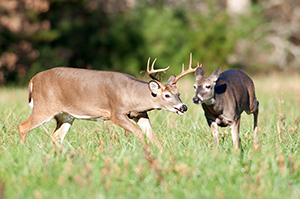
We're on the hunt for more deer data, and you can help.

Hunters are Maine's best shot for November deer observations.
With or without harvest, your time afield is an opportunity for valuable deer data and your expertise makes significant contributions to Maine deer management. Every rub or scrape you observe that others would miss, and every bird's eye view of an intense sparring match from your stand - it all helps biologists nail down Maine's deer breeding season calendar.
Community science hours are 24/7, there's no limit on deer data submissions, and the Rut Watch season runs all the way to December 31. Add the challenge to your season and share what you see!
- Location
- Date and time
- Breeding behavior or sign observed
What to watch for

Sparring
After bucks shed their velvet, sparring helps sort out who is who in the dominance hierarchy. Early season matches are often less intense than later season matches between similar sized bucks. Most sparring is complete by the time breeding begins.
|

Chasing
Before a doe is receptive, bucks will follow in her wake. They typically trail behind, often seen with nose to the ground, but may occasionally get close to the doe.
|

Rubs
Don't just look for deer, pay attention to the trees. Rubs are marks made by bucks when they rub their antlers on trees, removing bark and leaving their scent calling card in the process.
|

Scrapes
Look to the forest floor for this sign of breeding season behavior. Scrapes consist of two parts - a licking branch, and a patch of cleared earth. Bucks break a low branch around head height, then paw at the leaves below to expose the dirt. Covered in scent, a scrape tells does and other bucks, "I'm here!"
|

Active Breeding
The most obvious breeding behavior to observe is a buck mounting a doe, but that is a rare sight as it only lasts a moment. You are more likely to witness a buck "tending" a doe, following closely, chasing, nuzzling, or pawing at her rump until she is receptive.
|
|