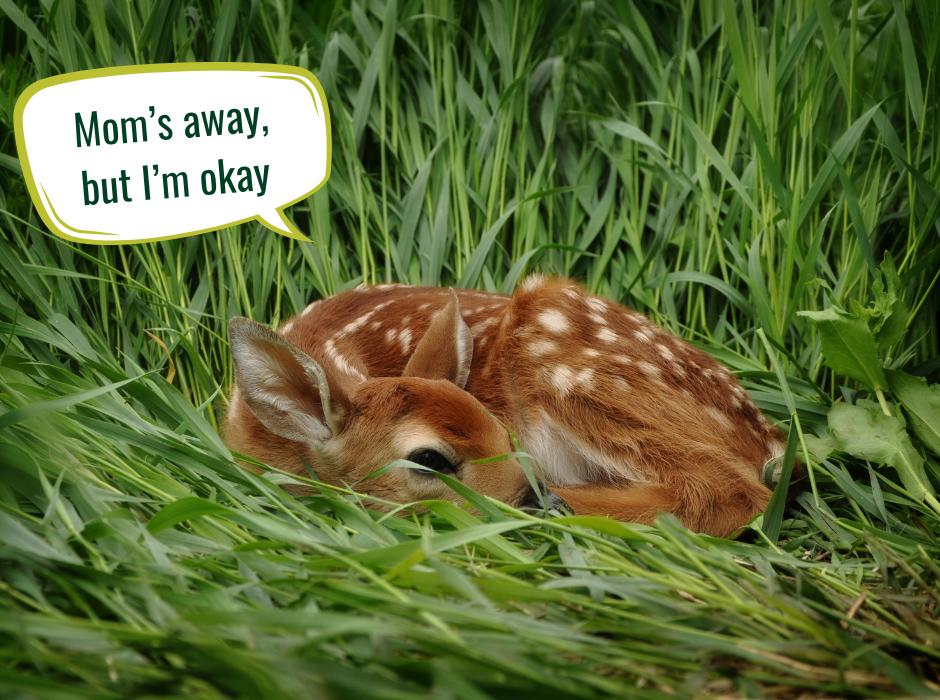
If you care, leave them there
It is not uncommon to find a young fawn all alone in the spring and early summer, but the vast majority are not orphans. Laying low and blending in is a fawn's survival strategy, and it works!
Until fawns are strong enough to keep up, an adult doe will hide them in tall grass or forest floor leaves, returning just two or three times a day to nurse. During this time, the fawn is protected from predators by its camouflaged coat and its lack of scent.
A wild upbringing is irreplaceable. Fawns raised by their mom without human intervention have a significantly higher chance of long-term survival. Trusting a doe to do her job and giving her space to do so is the most important action you can take.
Repeated visits to a fawn can draw the attention of predators, and could discourage the mother from returning. If you find a fawn, quietly leave the area, and make sure kids and pets do the same.
To determine if the fawn is truly injured or orphaned, please visit our website at mefishwildlife.com/fawn
Always call before you act.
Wildlife professionals such as wildlife conflict agents, Maine game wardens, wildlife biologists, licensed wildlife rehabilitators, and Animal Damage Control agents can help you assess different wildlife scenarios to determine the best course of action. For your safety and the safety of the animal, never handle, move, or feed wildlife unless directed to do so by a wildlife professional. In the rare cases when intervention is justified, their knowledge and experience will help ensure the safety of all those involved.
For deer, bear, moose, and turkey exhibiting signs of critical illness or injury, please contact your local MDIFW wildlife biologist or game warden. For all other species, please contact a licensed wildlife rehabilitator or Animal Damage Control agent.
It’s against the law to possess wildlife without the proper state and federal permits. Never attempt to rehabilitate wildlife yourself. Only licensed wildlife rehabilitators have the experience, knowledge, skills, and access to resources necessary to provide professional medical care, protect against zoonotic disease transmission, meet specific nutritional and husbandry needs, and condition wildlife for release. Even temporary care outside of a professional setting can do more harm than good. Thank you for helping keep Maine's wildlife wild!
|